 |
 |
 |
 |
Pakenham History : A Pakenham Mystery?
The following article was written (and kindly submitted) by Robin Imray and appeared in the East Anglia Daily Times 15th March 2002
SECRETS OF THE FAMILY FROZEN IN TIME
This is a detective story. It has mysteries and clues, a woman's grave, a soldier with a strange un-English tassel to his cap, a ferry ride, a group of children skipping. The trail leads from a Devon jumble sale to a Suffolk farmhand and a Belgian village. But there is no known crime, no victim. Even witnesses are missing ... unless of course that is you.
A friend bought them in Devon 20 years ago, four hundred photographs jumbled into shoe boxes. There was nothing much to show where they had come from, and they were negatives - hard to understand. To print them would cost a fortune. So they sat there. Only the arrival of computers and affordable scanners made it possible to turn them positive and investigate their secrets.
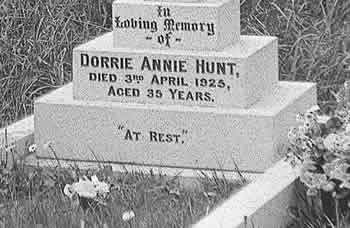
They are old (first guess said 1920s), obviously a family collection. There are wedding photos (the groom in uniform with a curious tasselled cap), seaside and farm scenes, a boat trip, an old man with two women, remarkably alike.
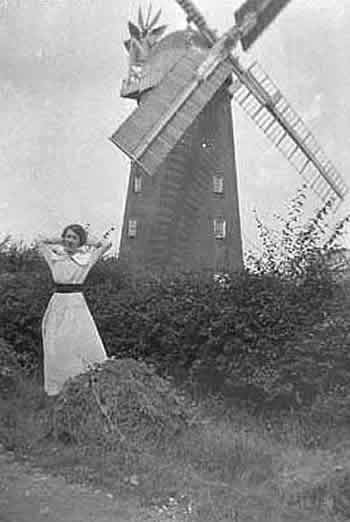
There is a windmill, and a period car. Nothing tells us where we are or what we are looking at ... until the grave.
It is a new grave, with shining stone, fresh flowers, crisp lettering. Framed centrally, it is the purpose of the picture: the dead person was important to whoever took it.
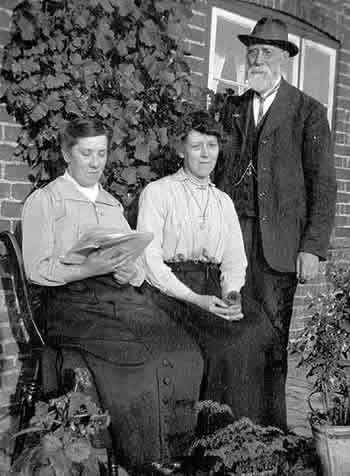
One of the glories of old photographs is their detail. Slow shutter speeds and fine emulsions meant wonderful precision. Scan them carefully, zoom in, and letters a millimetre high are readable.
Births, marriages and deaths are helpful to researchers: they must be registered, and the registers are public. Dorrie's certificate says she died of tubercular peritonitis at the West Suffolk General Hospital; that she was a nurse/domestic and unmarried; that her father, Alfred Hunt, was a shepherd on a farm; that she had lived with her parents at Old Hall Cottage, Pakenham.
Place-names clue you in. The Ordnance Survey map shows Old Hall, a mile north of Pakenham. Nearby is the symbol for a windmill. Contours and streams depict the land as flat and fenny, just as in the photos. Suffolk guide-book pictures confirmed the mill as Ixworth, and identified another image - Bury's abbey gateway. The local link was strengthened when a zoom-in on the old car's number read CF234. An expert explained this as West Suffolk registration. Such experts now came fully into play, and new technology. The internet is a paradise of pundits.
Somewhere there is a web-site or discussion group for everything, and a little magic wand called Google helps you find it. If nothing else, there is the email address of someone in the know, and you can send photographs by email. So Beaulieu Motor Museum confirmed the car as a Model T Ford of 1917-1919.
The ferry (zoom in on the lifebelt) is labelled as the Princesse Elisabeth of Ostend. She worked the channel crossing, says the web, from 1905 to 1930, a revolutionary turbine steamer, which at one time held a speed record. Bit by bit the physical details, the wheres and whats, came into view.
The people were more difficult. It was a reasonable guess that one of the farmhands might be Dorrie's shepherd father, but how can you confirm it? Indeed which, if any, of the women might be Dorrie? A girl posed, awkwardly coquettish, by the mill? One of two others, so similar they must be sisters? Who is the old fellow with the beard, who the bridegroom soldier with his foreign-looking cap, and the chap beside the chauffeur in the car (who maybe lent his motor for the wedding)?
The foreign link was first to be resolved. There was the ferry to Ostend; and a group of girls with newspapers. Their titles could be read - De Standaard and Ons Volk. It was easy with the web to confirm both these as Belgian. So the search moved on to the picture of a flag, held up by three young men. It is embroidered with the words KERELS VAN LANAEKEN - Men of Lanaeken. Modern Belgian atlases had nothing. Only a lucky encounter with a 1930s guide-book gave an answer. The spelling has changed. Now Lanaken, it is a village near the border by Maastricht.
So the dead girl had a name - Dorrie Annie Hunt. She had a home - on Old Hall Farm by Pakenham. And there was a Belgian village called Lanaeken and the wedding to a foreign soldier. The pictures had at last some detail, but were tantalisingly incomplete.
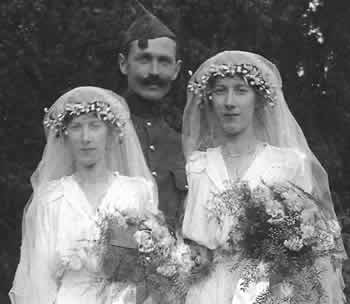
It might well have stayed so but for Martin Harrison at Bury archives. Contacted through email, and with a personal interest (he lives in Pakenham), he zeroed in on parish records. In an amazingly short time he found a wedding register.
On August 21st, 1919, Lambert Marie Antoine Martens, of Lanaeken, Belgium, married Ethel May Hunt, of Old Hall Cottage, Pakenham. He was 29, his bride 23. His father was a postal worker, hers a shepherd.
So this was Dorrie's sister. In one wedding photo, Ethel is with her husband; Dorrie stands as bridesmaid on her left. It's a start in the decyphering.
You can guess further: the two women with the old and bearded man are so like Dorrie and her sister that surely they're related? The girl posing by the windmill appears in other photos. Could she be an Easlea, daughter of the man who owned the farm? There are other family groups; perhaps the Belgian in-laws?
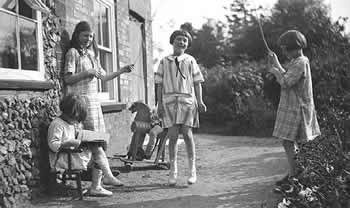
Then, there are the children skipping: the girl caught in mid-air appears in other shots. It is possible she grew up on the farm.
On the left, holding the rope might be her sister. The girls, the rope, the smiles are frozen in their time. But they could just be still alive.
They need names and futures to release them ... Is there a reader who can help?
Please contact Robin Imray (updated April 2014) if you recognise any of these people or have any information to add and especially if would like to see more photographs.